
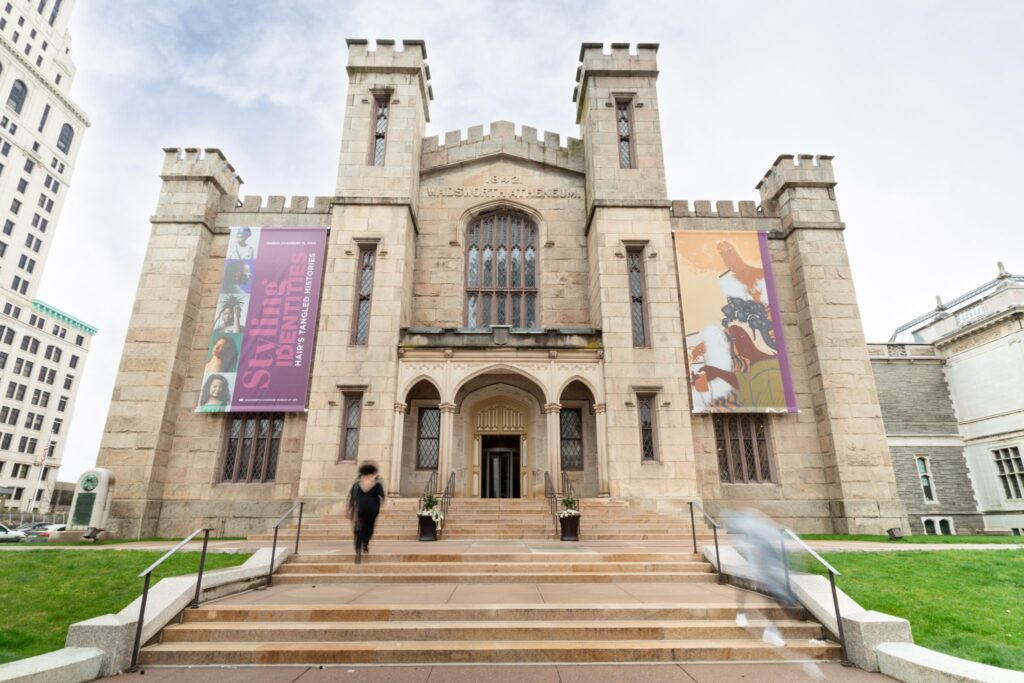
In a city whose fortunes have risen, fallen, and transformed, the Wadsworth Atheneum has held its ground. It is Hartford’s oldest public art museum, a title that speaks to endurance, but its true story is one of persistent, active presence. For over 180 years, it has functioned not as a relic, but as a central, argumentative, and vital piece of the city’s identity—a constant in Hartford’s core, both physically on Main Street and in its cultural consciousness.
Its 1842 founding was an act of civic ambition. Industrialist Daniel Wadsworth didn’t establish a private cabinet of curiosities; he created a public institution for “the increase and diffusion of knowledge and taste.” The choice of the word “Atheneum”—a society for learning—over “museum” was deliberate. The Gothic Revival castle that housed it was a bold architectural statement meant to signal that art and ideas were of central importance to the community. From the start, it was built for public access, a radical idea at the time that established its enduring mission.

The museum’s permanent collection is the deep bedrock formed by this long history. It is famously broad, a reflection of both focused curation and generations of patronage from Hartford’s industrial families. Key strengths include the Morgan Collection of European decorative arts, a significant trove of Baroque painting (including major works by Caravaggio and Zurbarán), and the iconic Colt Collection of firearms, presented as objects of both technical ingenuity and ornate craft. These galleries offer a walk through centuries of artistic endeavor, providing the foundational weight against which the museum has always tested new ideas.
That testing reached its most dynamic peak in the 1930s under Director A. Everett “Chick” Austin Jr. Austin transformed the Atheneum from a respected repository into a national provocateur. He didn’t just acquire modern art; he weaponized it to jolt the public. His landmark 1931 exhibition, The Newer Super-Realism (now called Surrealism), introduced America to Dalí, Ernst, and de Chirico. In 1934, he organized the first comprehensive Picasso retrospective in the United States. This was audacious programming for a conservative insurance capital, and it deliberately placed Hartford on the international art map. Austin saw the museum as a total performance space, producing Gertrude Stein’s avant-garde opera Four Saints in Three Acts with an all-Black cast. This era cemented the Atheneum’s DNA: it is an institution that believes in art as a live, disruptive force.
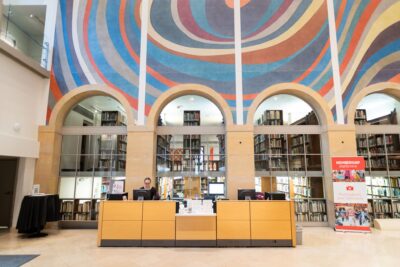
This spirit of engagement defines the visitor experience today. A tour through the interconnected buildings is a deliberate chronological collision. You move from the serene, gilded frames of the Hudson River School—a movement with deep Connecticut ties—into the clean lines of the Sol LeWitt wall drawing retrospective, a permanent installation that is itself an act of ongoing performance as it is recreated by hand. You might pass a gallery of 18th-century portraiture to enter a room pulsing with a contemporary video installation. This isn’t chaotic curation; it’s a philosophical stance. The Wadsworth insists that art is a continuous conversation, and that understanding a Renaissance altarpiece can be deepened by confronting a modern abstract piece in the next gallery.
Beyond the galleries, the Atheneum maintains its role as a public square. Its First Thursday social events and Second Saturdays for Families program continue Austin’s ethos of breaking down barriers to access. The museum’s theater has hosted everything from film series to lectures by artists like Andy Warhol, maintaining its stage as a platform for dialogue.
In an era where museums often choose between being classic repositories or trendy contemporary centers, the Wadsworth Atheneum steadfastly refuses the choice. Its strength and its challenge lie in its commitment to being both. It is the keeper of deep, traditional collections and an ongoing commissioner of new work. It is a Gothic castle that thinks like a modernist box. This duality is its identity. It has witnessed Hartford’s zenith and its struggles, and through it all, it has remained—not as a silent witness, but as an active, arguing, and essential participant. It is, and has always been, Hartford’s artistic constant.
The Wadsworth Atheneum is located at 600 Main Street, Hartford, CT. It is closed on Tuesdays and Wednesdays. Its dynamic schedule of exhibitions, performances, and public programs makes checking their website essential before a visit.